 pea






Three things to know
- Sugar in blended fruit counts as free sugar; sugar in whole fruit does not.
- Milk, yogurt or kefir adds protein to a smoothie.
No smoothie treats PCOS, now also called PMOS, and we found no study of smoothies in PCOS. The NHS says to keep fruit juice and smoothies to 150 mL a day in total, because blending fruit releases its sugars, and to have them with a meal.1 Blending fruit with milk, yogurt or kefir adds protein.
The 2023 PCOS guideline found no evidence that one diet is better than another, so a smoothie is a choice, not a requirement.2
How much smoothie can I have?
The NHS counts 150 mL of fruit juice, vegetable juice or smoothie as one of your 5 A Day, and only once a day, however much you drink. It suggests having them at mealtimes to protect your teeth. Whole fruit is different: 80 g of fresh, frozen or canned fruit is one portion, and you can have several.1
Why does blended fruit count as sugar?
The sugar in whole fruit and in milk does not count as “free sugar”. The sugar in fruit juices and smoothies does, because blending releases it. The NHS says adults should have no more than 30 g of free sugars a day.3 Shop-bought smoothies can have a lot, so check the label.
What goes in a smoothie with protein and fiber?
One way to build one from the NHS Eatwell Guide’s food groups:4
| Part | Examples |
|---|---|
| Protein | Greek yogurt, kefir, milk or unsweetened soy drink |
| Fruit or vegetables | A handful of frozen berries, a banana or a handful of spinach |
| Something more | A spoon of peanut butter or ground flaxseed |
The Eatwell Guide suggests lower-fat and lower-sugar dairy or alternatives.4 Skip juice as the liquid: it adds to your 150 mL.
A smoothie recipe from this site
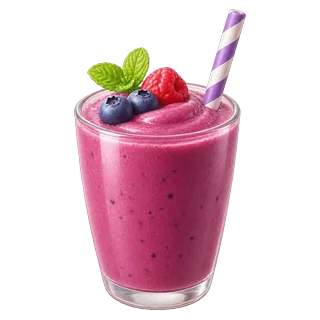
The berry kefir protein smoothie blends 250 mL of kefir with 100 g of frozen berries, a spoon of peanut butter and a spoon of ground flaxseed. Per serving, estimated from the ingredients: 320 calories, 15 g of protein, 25 g of carbs and 8 g of fiber. The NHS’s 150 mL limit is written for fruit and vegetable juices and smoothies, and it does not say how to count a drink that is mostly kefir; ours has 100 g of fruit, a little over one 80 g portion.1
Is a smoothie better than eating fruit?
Not by the NHS’s rules: whole fruit counts as a portion every time, while juice and smoothies count once a day and their sugar counts as free sugar.13 If you want more protein at breakfast, see the 30-30-30 rule and its four breakfasts, or the PCOS diet for a whole day.
Sources
- NHS. 5 A Day: what counts?. Reviewed 9 June 2026.
- J Clin Endocrinol Metab. Recommendations from the 2023 International Evidence-based Guideline for the Assessment and Management of Polycystic Ovary Syndrome. Published 15 August 2023. Recommendations used on this page: 3.3.1.
- NHS. Sugar: the facts. Reviewed 19 May 2023.
- NHS. The Eatwell Guide. Reviewed 29 November 2022.
Sources checked 15 November 2026.
In Pea, a photo of a meal like these gets a score out of 100 and the one change that would raise it. Get Pea for iPhone