 pea







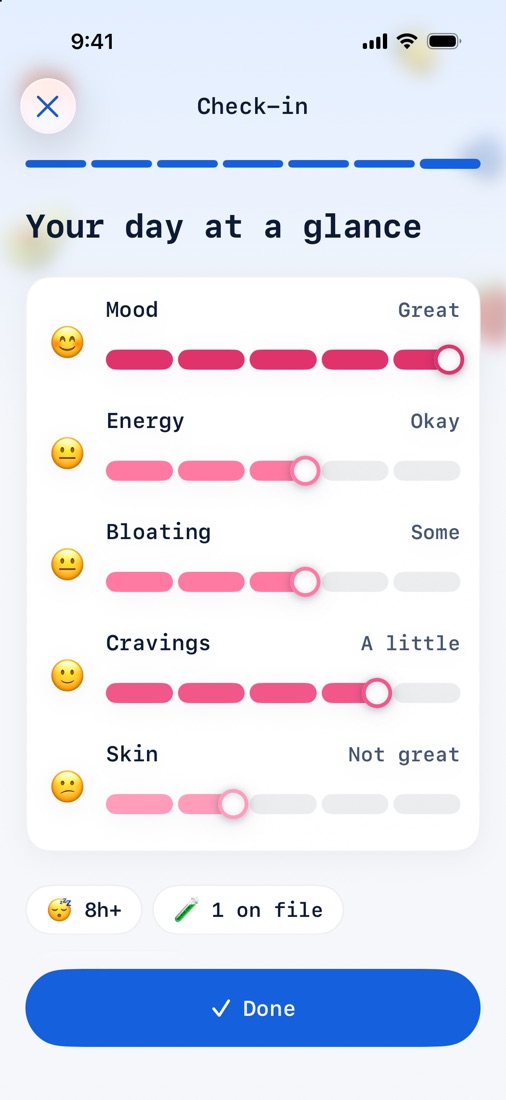
Our pick of the PCOS check-in apps (PCOS is also called PMOS) is Pea: a one-minute check-in on five sliders for mood, energy, bloating, cravings and skin, with your average by day and week and how you have felt over 30 days.1 AskPMOS, Peach and a plain notes app are compared below; whichever you use, a daily check-in should take about a minute and ask the same few questions each day.
Three things to know
- A daily check-in should take about a minute.
- Don’t fill in missed days from memory.
- If something is new or getting worse, see a doctor without waiting for the record.
This page is about the daily habit. For keeping a fuller record of symptoms for your doctor, see the best PCOS symptom tracker apps.
What is a daily PCOS check-in?
A few quick answers about how today went, at the same time each day. It gives you a dated record, so that before an appointment you can see which weeks were hard instead of guessing.
PCOS check-in apps compared
| Option | What it asks | What you get back | US price listed |
|---|---|---|---|
| Pea (our pick) | Five sliders: mood, energy, bloating, cravings and skin, with sleep and more if you want | Your average by day and week, 30 days of how you felt, and a one-page PDF for your doctor | $49.99 a year ($29.99 a year also listed), $6.99 a week or $129 for life1 |
| AskPMOS | A symptom tracker | A record to share with your health care team | Free2 |
| Peach | A daily mood check-in with notes, and symptoms on a severity scale | Your patterns, a PDF report and a data export | $6.99 a month, $29.99 to $39.99 a year, $13.99 a week or $199 for life3 |
| A notes app | Whatever you write | One dated line a day | Free |
How long does a check-in take?
About a minute. Pea’s check-in is described as one minute on sliders.1 A one-line note takes less. If yours takes longer, cut questions until it doesn’t.
A one-minute version with no app:
- Energy today: low, okay or good.
- Mood: low, okay or good.
- One thing you want to remember, if any.
How do I make a daily check-in stick?
Tie it to a moment that already happens every day, such as finishing lunch or plugging in your phone. If that stops working, pick a different moment. The 2023 international guideline lists self-monitoring and goal setting among the strategies that can support healthy habits in PCOS.4
What happens if I miss a few days?
Nothing. Start again today. Don’t fill in days from memory, because a guess makes the record less useful.
Is a check-in different from a symptom tracker?
Yes. A check-in is the same few questions each day, done quickly. A symptom tracker is the longer record you build from it, often with your periods, medicines and notes, to take to a doctor. Pea does both in one app.1 Our symptom tracker comparison covers the second job, with Clue and Flo.
How do I use what I wrote?
Before an appointment, pick the two or three things that got in the way most. Pea makes a one-page PDF of your symptoms, cycle, sleep and meals.1 The free daily check-in sheet on this site prints 30 days or saves a CSV, and the visit prep kit turns it into questions.
If something is new or getting worse, see a doctor without waiting for the record. The NHS says to see a GP if your symptoms are affecting your everyday life, work or relationships.5
Sources
- Apple App Store (US). Pea: app listing. Read 15 November 2026.
- Apple App Store (US). AskPMOS (formerly AskPCOS), Monash University: app listing. Read 15 November 2026.
- Apple App Store (US). Peach: PCOS Coach & Tracker: app listing. Read 15 November 2026.
- J Clin Endocrinol Metab. Recommendations from the 2023 International Evidence-based Guideline for the Assessment and Management of Polycystic Ovary Syndrome. Published 15 August 2023. Recommendations used on this page: 3.2.1.
- NHS. Polyendocrine metabolic ovarian syndrome (PMOS). Reviewed 30 June 2026.
Sources checked 15 November 2026.
Everything Pea does, and what it cannot do, is on one page. What Pea does